
Exchange of experience between projects as a resource for higher education development
Contemporary Ukrainian universities, fulfilling their third mission, act as active partners of communities in the processes of post-war recovery: from supporting veteran reintegration to developing models for the recovery of border territories. Chernihiv Polytechnic National University has been working in this direction for several years, in particular through participation in international and national projects, whose synergy is increasingly becoming a determining factor in the quality of higher education: when the research findings of one project reinforce the educational products of another, the university gains the ability to offer solutions grounded in real needs. A notable example of such cooperation is the collaboration between the teams of the TURBO project “The Universities’ Reaction to Big Obstructions: Building resilient higher education to respond and manage societal crises” and the young scientists’ research project “Service Learning Model for Ensuring Resilience and Post-War Recovery of Ukraine’s Border Communities” (state registration number 0126U001542), implemented with the financial support of the Ministry of Education and Science of Ukraine.
The project “Service Learning Model for Ensuring Resilience and Post-War Recovery of Ukraine’s Border Communities” is aimed at integrating the Service Learning approach — learning through socially beneficial activity — into the work of universities. One of the first stages of the team’s work was an empirical study covering communities in Chernihiv Oblast, intended to identify the actual challenges faced by border regions and the potential that stakeholders see in cooperation with the university. Based on the survey results, the team prepared an analytical report.
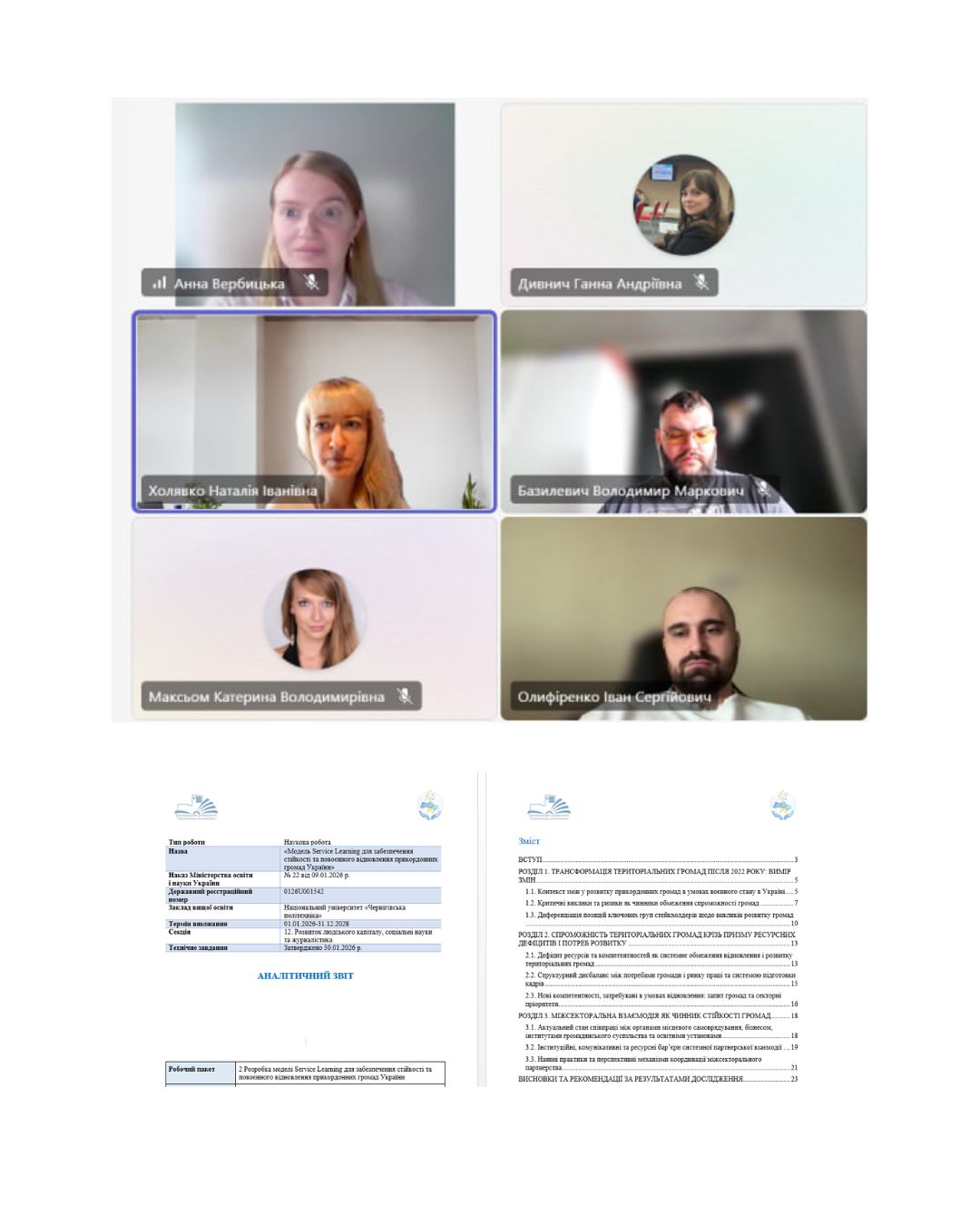
On July 28, 2026, a working meeting of the heads and team members of both projects took place. Natalia Kholiavko, head of the young scientists’ project, presented the report, after which the meeting participants discussed the key findings of the study and the real needs expressed by representatives of business, the civic sector, educational institutions, and local government.
The analytical data obtained within the framework of the “Service Learning Model for Ensuring Resilience and Post-War Recovery of Ukraine’s Border Communities” project hold significant value for the TURBO project team. The study identified needs for training and reskilling among vulnerable groups in border communities, particularly internally displaced persons, and outlined specific features of the local labor market. It is important to understand that these needs are not static: the situation in border communities is changing — the profiles of displaced persons are shifting, demand for certain professions fluctuates, and new security- and economy-related challenges continue to emerge. For the TURBO team, it was therefore essential to obtain a current, “living” picture of these needs — one that accounts for this dynamic and makes it possible to shape an educational offer relevant to present conditions.
Following the meeting, the teams agreed to continue exchanging research results, as well as to take part in joint activities at the intersection of the two projects’ themes and areas of focus.
The main aim of TURBO project “The Universities’ Reaction to Big Obstructions: Building resilient higher education to respond and manage societal crises” is to increase the resilience, preparedness and responsiveness of Ukrainian higher education institutions (HEIs) by building their capacities, improving competencies and sharing experiences. This project has received funding from the European Union (ERASMUS-EDU-2023-CBHE) under grant agreement No 101129315. This material reflects only the views of the authors and does not necessarily represent the official position of the European Union.