Launch of the course as part of the AIFEU project (Erasmus+ Jean Monnet Module)
On 4 March 2026, the course “Artificial Intelligence in EU Financial Institutions” will commence. This course is being delivered as part of the international AIFEU project under the Erasmus+ Jean Monnet Module programme. The initiative aims to develop modern competencies in the use of artificial intelligence technologies in the European Union’s financial sector and to train specialists capable of working in the context of the digital transformation of financial systems.
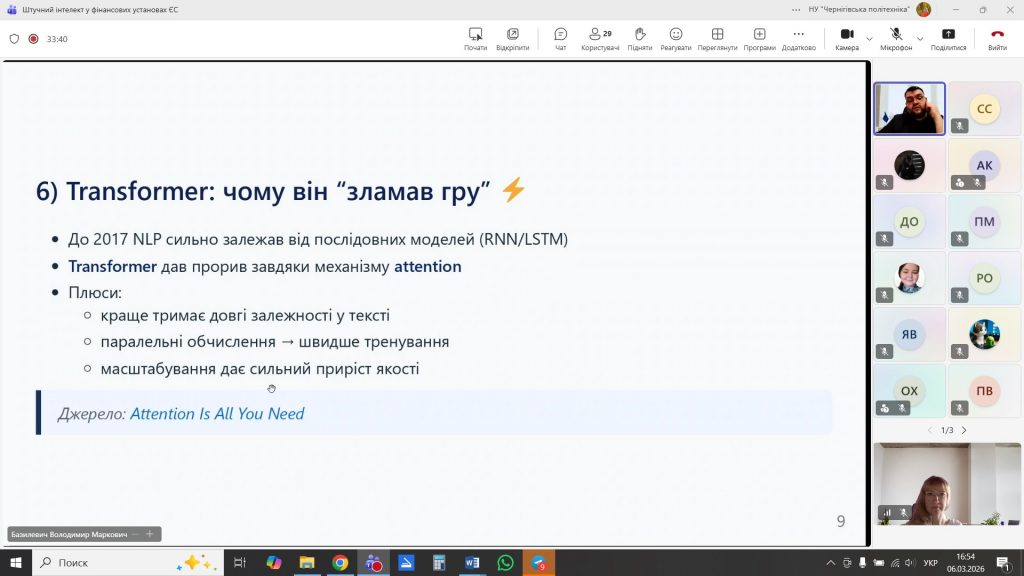
The first teaching module of the course – a technical block devoted to the basic principles of how artificial intelligence systems function – was launched by Volodymyr Bazylevych, PhD in Economics, Associate Professor and Director of the Educational-Scientific Institute of Electronic and Information Technologies at Chernihiv Polytechnic National University. The first lectures laid the foundations for understanding modern artificial intelligence tools, which are being used increasingly actively in financial institutions across the European Union and Ukraine.
During the first sessions, course participants were introduced to the evolution of artificial intelligence technologies – from early research to modern machine learning models. Significant attention was paid to the key stages in the development of the field, as well as to the periods of so-called “AI winters”, which shaped the dynamics of scientific research and technological breakthroughs.
A separate block of lectures was devoted to the modern technological foundations of artificial intelligence, in particular areas such as machine learning, deep learning, natural language processing and computer vision. Participants gained a systematic understanding of how modern algorithms process data and how models analyse textual information.
Particular attention was paid to the principles of operation of large language models (LLMs), which underpin many modern digital services. The stages of training such models were examined – from pre-training to fine-tuning and alignment procedures.
The technical lectures of the course also discussed the limitations and risks of using artificial intelligence, including the phenomenon of model hallucinations, potential biases in the data, and the challenges associated with interpreting the results of algorithms. Participants were introduced to practical approaches for the effective use of artificial intelligence tools, including rules for formulating queries, verifying information, and working with context.
In addition to technical aspects, the lectures also covered the areas of application of artificial intelligence – from everyday services to medicine, education, the financial sector and others. Significant attention was paid to the role of artificial intelligence technologies in the economy and business, particularly in the context of transformations linked to the concept of Industry 4.0. The prospects for the further development of these technologies were also discussed, including possible scenarios for the emergence of general artificial intelligence systems, as well as their impact on the labour market, ethical standards and society as a whole.
The lectures provided an important start to the course and laid the theoretical and technological foundations for further study of the practical aspects of applying artificial intelligence in financial institutions within the European Union.
The AIFEU project is co-funded by the European Union; however, the views and opinions expressed belong solely to the authors of this project and do not necessarily reflect the views of the European Union or the European Education and Culture Executive Agency. Neither the European Union nor the grant provider can be held responsible for them.