Launch of a series of training sessions as part of the P2R “Pathways2Resilience” project
On 3 March 2026, a series of capacity-building training sessions began as part of the Horizon Europe project “Pathways2Resilience: Jointly developing pathways towards climate-resilient regions in Europe”. The programme of events is dedicated to preparing sub-grant recipient teams to develop high-quality strategies for adapting to climate change and integrating the principles of climate justice at regional and local levels. Chernihiv Polytechnic National University was represented by a team comprising Prof. Zh. Derii, PhD in Economics; Prof. N. Kholiavko, PhD in Economics; postgraduate students M. Koriavets and M. Poliansky; and undergraduate student V. Bibik.
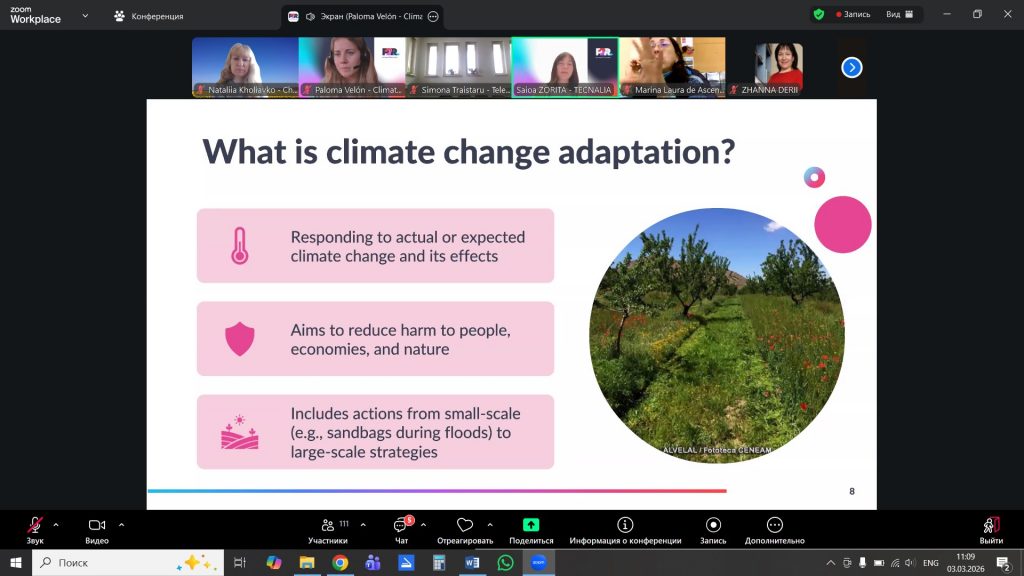
During the event, the key principles of transformational adaptation to climate change were examined, and various forms of adaptation (institutional, technological, economic, behavioural, and environmental) were analysed. Particular attention was paid to the depth and scale of transformations, their systemic impact on community development, and ensuring the inclusivity of decision-making processes. The analysis of international case studies, in particular the experience of the Métabief ski resort, which is undertaking a strategic restructuring of its development model in response to climate challenges, was of practical interest. This example demonstrated the importance of a long-term vision, diversification of economic activity, and the active involvement of the community in decision-making. During the first training sessions, emphasis was also placed on the need for systematic strategic planning, the integration of climate goals into local policies and development documents, as well as effective engagement with a wide range of stakeholders – public authorities, businesses, educational institutions and civil society organisations.
Participation in the event enabled the university team to deepen their expert knowledge in the field of climate risk management, adaptation planning and transformational change. The findings will be used to implement the project “Chernihiv for Climate Action and Sustainable Transformation” (https://stu.cn.ua/mizhnarodna-diyalnist/mizhnarodni-programy-ta-proekty/proyekt-p2r/).
This project has received funding from the European Union’s Horizon Europe research and innovation programme Pathways2Resilience under grant agreement No 101093942. The European Commission is not responsible for any use that may be made of the information it contains.